Friday, October 14, 2011

A Movement from the Margins, Part 1

By Jonathan Kindberg


One of the most satisfying and exciting aspects of my ministry has been discipling some new believers who I’ve tasked with going out on mission from the earliest days of their new walk with Christ. In each case God has met them in profound ways as they are sent out. In this I’ve sought to follow the pattern in Luke 9 and 10 of Jesus sending out his disciples.

Many might ask: Why did Jesus send out his disciples so quickly after they had begun to follow him? You can almost hear the complaints that immediately arose from the disciples:  “We are doing what? But, Jesus, we aren’t ready yet!”  or “Jesus we haven’t had enough training. What if we don’t know what to say?” And in reality they didn’t have enough resources and training… and this was exactly the point.

Jesus purposefully sent them without the resources they “needed:” “Take nothing for your journey,” he instructed them. “Don’t take a walking stick, a traveler’s bag, food, money, or even a change of clothes” (Luke 9:3). They had no resources and very little training. They hadn’t even been with Jesus for 5 chapters! But this he gave them: his own power and authority (9:1).

When we go out on mission something quite mysterious happens. We immediately recognize that we don’t have what people need. People bring their problems and pain and we don’t have the right answers or things to say. Immediately we recognize that we are empty people trying to fill others’ vacuous souls and we have come up dry. At that point, though, of recognizing our emptiness, a miraculous exchange occurs. God fills us, meets us at our point of need, so that we are able to meet the needs of others. We come to the end of ourselves and begin to depend on his authority and power to work in our own lives and in the lives of others.

Discipleship or spiritual formation without mission, even from the earliest stages of growth in Christ is incomplete to say the least. It is, as a friend of mine pointed out, a rediscovery of what it means to be truly human as God intended, a “being for the sake of others.”

Evangelical discipleship often emphasizes being “filled” which most often translates into a passive receiving of unidirectional teaching/preaching and a host of small groups, books and Sunday school classes. No wonder so many leave our churches looking for greener pastures and complaining of not having been “fed.” The problem often is that they have actually been “overfed” but haven’t been feeding others. Their hearts have become a stagnant pond of water without an exit strategy.
So what happens when these un-resourced, untrained disciples go out? By chapter 10, the 12 have suddenly become 72. A movement from the margins has begun.

In the next post we’ll talk about how movements usually begin in this way and are carried by the poor and outcasts of society, by those on the margins, and what one could look like here in Chicago started by Hispanic immigrants.

Friday, August 26, 2011

Jericho Road Improvement Association

By Jonathan Kindberg

Almost every week this past summer someone from my congregation or someone I knew within the larger Hispanic immigrant community in DuPage County was arrested and faced possible deportation. Each time a flurry of phone calls, jails visits, attorney finding, money gathering, praying and waiting ensued.

Martin Luther King Jr. once said:”On the one hand we are called to play the good Samaritan on life’s roadside; but that will be only an initial act. One day we must come to see that the whole Jericho road must be transformed so that men and women will not be constantly beaten and robbed as they make their journey on life’s highway. True compassion is more than flinging a coin to a beggar; it is not haphazard and superficial. It comes to see that an edifice which produces beggars needs restructuring.”

In other words it’s good to help people laying on the side of the road, but after doing this over and over you start realizing that it’s time to actually do some work on the road itself. So each week at Iglesia, during the prayers of the people we pray for: Comprehensive Immigration Reform. 
Below is the beginning of a post from undocumented.tv which shares the story of someone at my congregation who was arrested this summer.

I wrote here about 6 weeks ago about the frustration and heartbreak of watching a family in my neighborhood suffer after the father of the household was stopped for a questionable traffic violation and then was turned over to Immigration and Customs Enforcement (ICE) on suspicion that he lacked legal status.
  He was detained for a week in a county jail, which rents space (in exchange for a substantial economic benefit to the county government) to ICE.  Then, because apparently there was more bed space available elsewhere, my friend was flown from Illinois to Colorado, where he spent three more weeks in a detention cell operated by a private corporation, at the taxpayer’s expense…for the full article see: http://undocumented.tv/2011/blog/frustration-anger-hope-gratitude/

Friday, August 19, 2011

Juntos Como Hermanos

By Jonathan Kindberg

Juntos como hermanos, miembros de la Iglesia, vamos caminando al encuentro del Señor. Together as brothers, members of the church, we are walking towards the Lord.

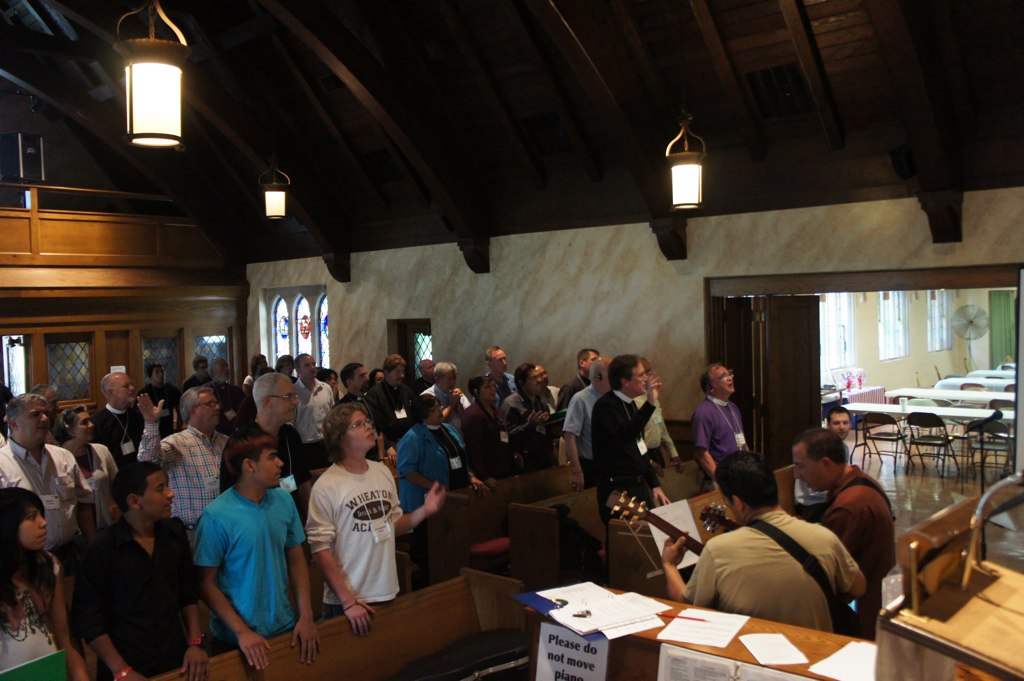
This first verse of a song entitled “Juntos Como Hermanos” spontaneously arose during the ¡Caminemos Juntos! Consultation on Hispanic Anglican ministry and summarizes the feeling of those gathered together for two days on the outskirts of Chicago. For most, it was the first time they had met each other. Many came to the conference feeling isolated and tired and left energized and united on a common mission. Folks all the way from Nuestra Señora de Guadalupe in Fresno, California, to All Nations Christian Church in New Haven, Connecticut came to talk about the potential and challenges of Anglican Hispanic ministry.
Our time together began with a charge from Archbishop Bob Duncan to have the Anglican church here on earth look like it will in heaven: diverse! We then heard from Fr. David Roseberry with Anglican 1000 and saw a video by Univision powerfully depicting the “New American Reality” of Hispanics in the United States. The U.S. census bureau estimates that by 2050 Hispanics will constitute 29% of the population of the U.S. and that minorities in general will be over 50% of the population. Another surprising statistic is that currently approximately 60% of Hispanics in the U.S. are English dominant.

Noteworthy was the address from Dr. Roberto Miranda, pastor of the congregation León de Judá in Boston and author of “En La Tierra de Los Peregrinos: La Iglesia Hispana Evangelica y Su Llamado Redentor.” His prophetic message was entitled:  the Hispanic Church as a Transformational Community (“La Iglesia Hispana Como Comunidad Transformadora”) and was based on the story of Jesus’ feeding of the 5,000. He stated that that Lord always delights to use the weak for his purposes and that, in his sovereignty, he has brought Hispanics with their strong faith to the United States to preserve and transform this country that is going down the path of secularization and materialism. He likened Hispanics in the Unites States to Moses growing up in Egypt unaware of his prophetic calling and invited us to awake to this prophetic responsibility and calling.
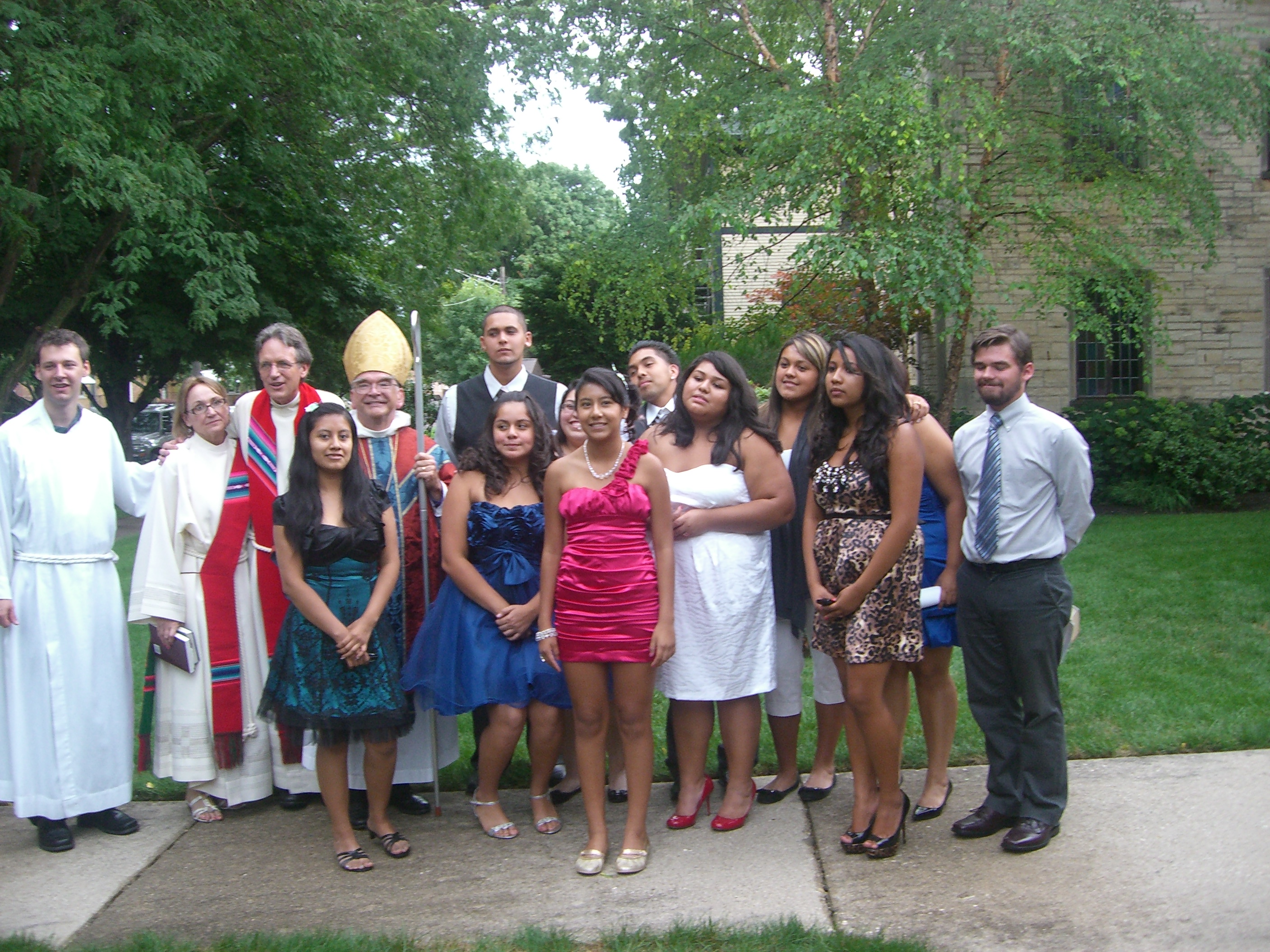
The conference ended with an ordination and confirmation service at Iglesia Santa Maria de Guadalupe, presided over by Archbishop Duncan. Catechist Fernando Moreno, from Iglesia del Sagrado Corazon de Jesus, a Greenhouse congregation in Chicago, was ordained a deacon and twelve youth from Iglesia de la Resurreccion and Santa Maria were confirmed.

Monday, August 15, 2011

Field Report from ¡Caminemos Juntos!

By David Roseberry


There is something awesome happening in Anglican1000. It is out of control!  Yes, that probably is a good thing to say about a movement.  Steve Addison in his book Movements that Change the World, writes that movements grow ‘at the edges’ of the organization and generally not from the center.  That means that a movement will not come from a ‘central headquarters’, but from the outer rims.

This is true of the efforts of Anglican1000 to support Hispanic church planting within the Anglican context in North America.  The vision of Anglican 1000 took hold at the recent convocation of Anglican Hispanic leaders and planters, a kick-start event called Caminemos Juntos (Let us Walk Together).  Approximately 50 leaders, clergy, laity, and a handful of bishops attended the two-day event outside Chicago.

The challenges for reaching the Hispanic population with the Gospel through the Anglican Church are quite complex.  There are first and second and even third generation issues.  There are self-perception challenges within the Hispanic culture itself.  It was clear from the presenters that the Hispanic people in the US and Canada see themselves as a culture and not a race.  Efforts to reach this culture need to be sensitive to a vast number of issues including the influence of the Roman Catholic Church, syncretism, immigration issues, and cultural definitions of family and church.
But make no mistake; ministry to the Hispanic community is an incredible opportunity for the Gospel of Christ.  Take a look at this video to get a sense of what might be possible for the Lord.

Insightful talks came from a number of Hispanic leaders around the country including Archbishop Robert Duncan, Gabe Garcia, Pdre. Alvaro Jinete, Dr. Roberto Miranda, and more.  We heard from people who are ministering among this population.  Some are rectors who have congregations that have started Hispanic works; some are stand-alone churches that minister in a mixed cultures.  Some are start-up house churches from the Greenhouse Movement; and some are new (or soon to be) church plants that have bi-vocational clergy. 
It is clear to me that there is a passion and solid base to see Anglican1000 take hold in the Hispanic Church-planting community.  I took the time to invite the leadership to attend the annual Anglican1000 Summit and give a major report on the work of these initiatives.


Thursday, July 14, 2011

First Briar St Bible Study

By Nick Raven, British intern from the newly formed AMiE (Anglican Mission in England).

‘…the Lord has sent me to bring good news to the poor, he has sent me to bind up the brokenhearted, to proclaim liberty to the captives, and the opening of the prison to those who are bound…’
-Isaiah 61:1

I have recently been reading ‘Celebration of Discipline’ by Richard J. Foster. In the book Foster talks extensively about submission. He asserts that true submission is liberating and gives us the freedom to serve, value and take greater interest in other people. It allows us to love unconditionally, not relying on receiving anything in return to make ourselves feel worthy. It is obedience to Christ then, that sets us free. It is a wholehearted submission to his call of discipleship that opens the prison to those who are bound.

In the lead up to our first bible study at Briar Street I was somewhat nervous about what would happen. Not only was it to be our first explicitly Christian meeting, but ours was also a very unlikely group of people who would not be expected to ‘gel’ in any normal setting. The demographic goes a little like this: A middle aged Puerto Rican woman and her teenage Puerto Rican-Mexican niece and nephew, a middle-aged African American pentecostal woman, a single Mexican man who speaks no English, four white Americans and a token Brit. What striking diversity! Within the group there is also a wide range of brokeness, some of which is very painful and deep-rooted.

So it was in submission to Christ, not through much confidence in our ability to bring these people together, that I approached the evening. How freeing to be able to commit the bible study into God’s hands and not feel the pressure of having to live up to any level of expectation. We started with a meal, which is our normal Sunday night community activity, then moved on to some singing. I have never experienced anything quite like the worship on Sunday night. It was brought to life so brilliantly through the vibrance and energy of the participants that it was hard not to feel that God was present, evident in our joy. Songs finished with shouts of ‘Amen!’ and “Now that’s what I call praise and worship!’, a reaction that I have sadly never been exposed to in a ‘conventional’ church setting. For the study Jonathan simply took us through the first chapter of Mark, posing the two great questions of the book, ‘Who is Jesus?’ and ‘What does it mean to be a disciple?’. Input was high, and genuine, searching questions were asked about the passage that propelled us into useful and profound conversation about Jesus. This was followed by a period spent in small groups praying, a time that was filled with heartlfelt sharing of some serious issues. It was truly amazing to be able to pray for the healing power of Jesus in the lives of these people and trust that he is in the process of changing them.

As in Isaiah 61, Jesus is the one who proclaims ‘liberty to the captives’ and brings ‘good news to the poor’. Many of our friends at Briar Street are captives, and many of them are poor both spiritually and materially. However when we are able to submit to Jesus in the way that Foster talks about, knowing that through this we are best able to serve him, there is a release from from any spiritual shacklement that remains within us and a greater ability to partake in God’s saving work. Let us hope and pray that our friends will come to know the joy that is found in serving God through submission to him and his will, and the freedom that gives us to live and work to his praise and glory!